
Category: Thought Leadership

  • Why We Start Every AML Search With Pedigree

    Why We Start Every AML Search With Pedigree

    One question we ask first: where have they worked?

    There’s one question we ask before any other when we open a financial crimes search: where have they worked?

    Not what’s on the resume. Not which keywords match. Where they actually did the work.

    In AML and KYC, pedigree isn’t snobbery — it’s prediction. A candidate who ran transaction monitoring inside a heavily examined institution has been shaped by an environment where mistakes have consequences. They’ve sat through regulatory exams. They’ve defended their alerts to people who get paid to second-guess them. That formation doesn’t show up in a keyword search, but it shows up the moment the work gets hard.

    We’ve spent 30 years learning to read it. Since 1996, we’ve built a database of more than 5,000 pre-vetted financial crimes professionals, and the thing we track most carefully isn’t certifications — it’s lineage. Where someone trained tells you how they’ll think when the stakes are high and the alert volume is overwhelming.

    That’s why a keyword match and a qualified candidate are not the same thing. Anyone can find a resume with “CAMS” and “transaction monitoring” on it. Knowing whether that person can actually carry a caseload at a Tier 1 institution under examination pressure — that takes someone who’s spent three decades learning the difference.

    Pedigree is the first filter because it’s the most predictive one. Everything else we screen for sits on top of it.


    If your current vendors are sending you keyword matches and calling them qualified, we should talk.
  • The Retention Story: Why Clients Stop Shopping

    The Retention Story: Why Clients Stop Shopping

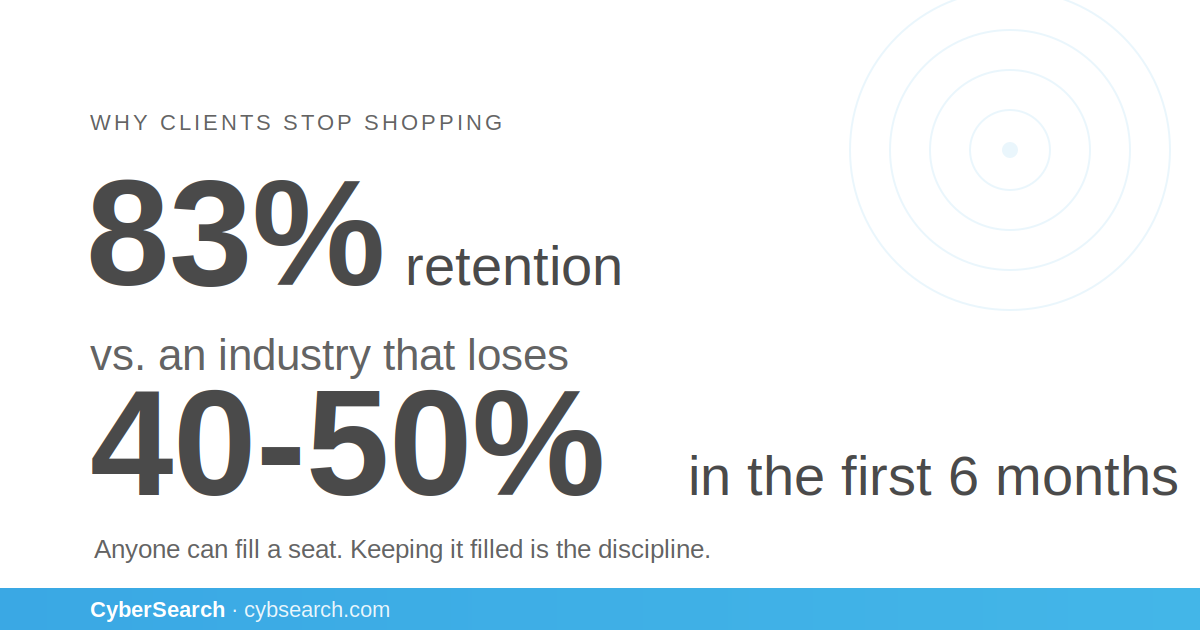
    83% retention vs. an industry that loses 40-50% in the first 6 months

    Speed gets you in the door. Retention is what makes a client stop shopping.

    We placed a large team of AML analysts on a program that grew from 50 seats to 150. A year later, 125 of them were still there. That’s 83% retention — on a program where most staffing firms lose 40 to 50% of their placements within the first six months.

    Here’s why that number matters more than the speed of the original fill. On a compliance program, turnover isn’t just a staffing inconvenience — it’s a regulatory risk. Every analyst who walks out the door takes case knowledge with them. Every empty seat is a gap in coverage. Every replacement has to be re-trained on the institution’s specific procedures before they’re productive. A program that churns half its staff in six months isn’t staffed — it’s perpetually re-staffing.

    So how do we hold people in place? It starts with the same thing that lets us fill fast: pedigree. When you place people who actually fit the work — who’ve done it before, at institutions like this one — they don’t bail in month three. They’re not in over their heads. They’re not surprised by what the job actually is.

    The other half is how we treat the people we place. We’re transparent about pay. We don’t bury a markup we’re ashamed of. People who feel respected and fairly compensated stay, and clients who don’t have to re-staff every quarter stop calling our competitors.

    Anyone can throw bodies at a requirement. Keeping those bodies in their seats for a year is a different discipline entirely — and it’s the one that ends the vendor bake-off.


    If you’re tired of re-staffing the same program every two quarters, let’s talk.